
This page answers a narrow question: does your sample actually need clamping on the exposure stage, and if a vacuum chuck can't grip it, what holds it instead? It matters because most research samples — a diced chip, a through-etched wafer, an odd-shaped piece — are exactly the parts a general-purpose chuck handles worst.
Everything below is qualitative — no numbers except a few fixed facts about the tool.
1 · What a chuck actually does
A chuck does three real jobs. It holds the sample against whatever motion the stage imposes so it can't creep or spin off; it pulls a bowed or warped substrate flat so the whole surface sits in one plane; and it gives the sample a repeatable reference plane, so the surface lands at the same height every time and stays inside the exposure's focus. A vacuum chuck does all three by pulling the sample down onto a plate through ports or grooves.
The word "chuck" covers two very different situations, though, and they don't have the same answer. On a spin coater the chuck spins the substrate at thousands of rpm while liquid resist is flung outward — there, vacuum (or a mechanical clamp) is non-negotiable, because nothing else keeps the wafer on the spindle. On an exposure stage the picture is different: the stage translates the sample in small steps under the optics, and whether it needs clamping at all depends on how hard that stage accelerates versus how much the sample's own weight and friction resist sliding.
2 · When a vacuum chuck earns its place
This list is shorter than most people expect. On a spin coater the chuck is non-negotiable, as above. On an exposure stage, the cases that genuinely call for one are narrow:
- Flexible substrates. A polymer film or foil doesn't lie flat by itself — it curls, lifts at the edges and traps air underneath. Friction fixes none of that, because the problem isn't the sample sliding, it's the sample not being flat. Vacuum is the practical way to pull a film down and keep it there for the whole exposure, and it's the case where the chuck's hole layout matters most: a film drawn onto widely-spaced holes can dimple over them.
- A badly bowed or warped substrate. Most wafers are nowhere near this. Normal bow on a flat, unstressed wafer sits well inside the depth of focus, and BEAM runs its through-the-lens autofocus before the exposure — so a surface that isn't perfectly flat gets focused rather than forced flat. Clamping becomes a real answer only at the extremes — a heavily stressed film stack, a thinned or very thin wafer, or a substrate that visibly rocks when you set it down.
- Mounting that isn't horizontal. A tilted fixture that would let a loose sample slide under its own weight needs the sample held down.
One reason you will hear that doesn't survive contact with the job: vibration. If the room shakes hard enough to walk a sample across a stage, it shakes far too much to hold a submicron feature in focus during the exposure — you'd have no pattern worth keeping either way. That's a bench, floor and environment problem, and no chuck fixes it.
Clamping a substrate flat isn't a free operation either, which is the other half of why the list above is short. Pulling a bowed or stressed wafer down onto a plate stretches it in the plane of its own surface, so features move sideways — scanner studies model that chucking distortion as a genuine contributor to overlay error, not a rounding term. And the flattening itself has a ceiling: the pin-chuck literature reports how much bow a given chuck geometry can actually pull out, and the wafer's edge is the hardest region to flatten — the seal ring that stops the leak is itself part of what limits it. Neither point argues against a chuck when the sample needs one — they argue against reaching for one by default.
Whether the exposure stage's own motion demands clamping is a separate question, and it comes down to physics: the acceleration the stage imposes versus the friction available to resist it. A stage that moves a sample gently enough never overcomes that friction, so it asks nothing of a chuck at all.
3 · When you don't need one — and when you physically can't use one
Here's the half that rarely gets said out loud: a vacuum chuck only works when the sample covers a port or groove ring and seals it. No seal, no suction, nothing to grip. The hold is just the pressure difference across the sample multiplied by the area actually sealed — the same arithmetic as a suction cup — so a sample that seals a small fraction of the plate gets a small fraction of the grip, and one that seals nothing gets none of it. And the samples researchers pattern most often are exactly the ones that can't seal.
- Small diced chips — the most common research sample of all. Whether one can be held depends entirely on the chuck's port layout, not on the chip: on a plate whose ports are spread out for full wafers, a few-millimetre piece covers nothing, seals nothing, and sits on what is effectively a dead surface. Concentrate the same suction into a small central zone and that chip holds fine. This one is a property of the chuck.
- Through-etched MEMS wafers and perforated or porous substrates leak: air pulls straight through the holes or the pore structure, and the vacuum never builds against the sample.
That first case is worth separating from the rest, because it can be designed away. NANYTE's standard vacuum chuck concentrates most of its hold into the central ~20 mm, so a small chip seals and grips instead of resting on a dead plate; a really small piece may still want a strip of aluminium tape. And because every chuck is machined to order, the central region can be sized to the samples you actually run — which takes the tape step out of a known part.
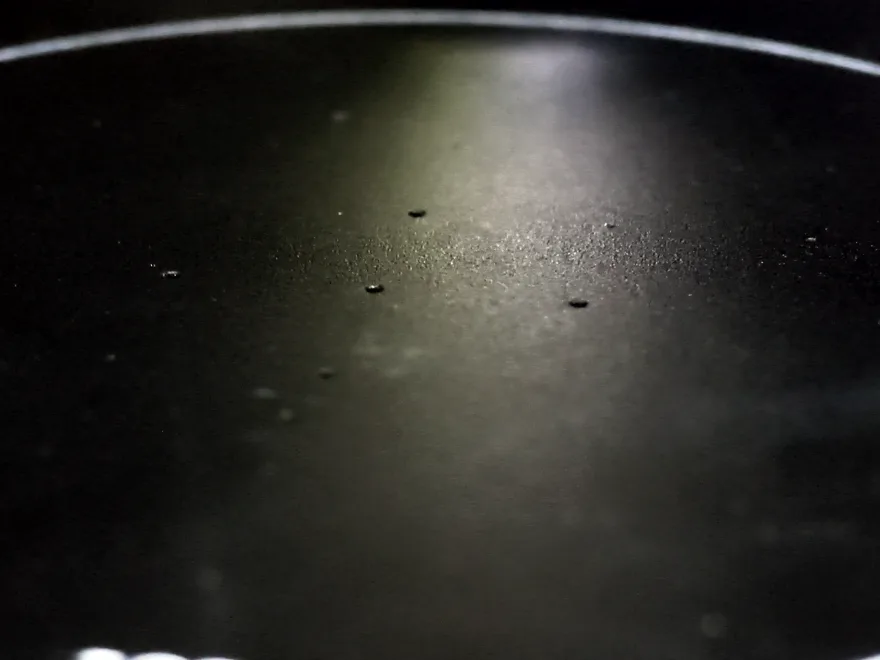
The other can't be machined around: a perforated or porous substrate leaks whatever the plate looks like — air keeps flowing, so no pressure difference ever builds across the sample, and there is nothing for the sealed area to be. So for a good share of real samples a chuck is either unavailable or beside the point — which raises the obvious question: what holds them? That's the next section.
4 · The alternative: a stage that moves samples gently
Start from the physics. A sample resting on a flat stage is held by friction alone, and friction is plenty — right up until the stage accelerates or decelerates hard enough to overcome it. It's the same reason a cup of coffee rides happily on the tray of a smoothly driven car but slides off the moment the driver brakes hard. Keep the acceleration below what friction can hold, and a loose sample never moves.
That trade is studied in its own right outside lithography: robotics calls it non-prehensile transport — moving an unclamped object that is held only by friction against the surface carrying it — and the control work there plans motions that keep the friction a move demands inside what the contact can actually supply. A precision stage is the easy end of the same problem: short travels, a known payload, and no reason to hurry the move.
That's the principle the NANYTE BEAM stage is built around. Its stage uses controlled acceleration and deceleration, so samples — including small diced chips — sit directly on the stage with nothing holding them down and stay put through a full multi-field exposure job. Samples from 0 to 7 mm thick sit on the stage as they are; BEAM takes samples up to 130 × 130 mm with a 106 × 106 mm writing area (6-inch on BEAM XL, 8-inch on BEAM XL8), with 0.1 µm bidirectional stage repeatability. For the narrow cases of Section 2, a vacuum chuck is still available as an option, machined to suit the samples you run — it's just not the default, because most samples don't need one.
5 · Verifying your sample hasn't moved
You don't have to take any of this on faith — there's a check anyone can run on any tool. Pick a recognisable reference on the sample surface: an alignment mark if you have one, or just any small defect you can spot again. Note where it sits in the tool's camera, run the exposure job, then send the stage back to its starting position and look again. If the reference sits exactly where it started, the sample never slipped.
Multilayer overlay is the stricter, cumulative version of this same question — every added layer has to land on the ones before it, so the tolerance is tighter and the errors add up. Alignment marks are the systematic answer to both: deliberate references you measure against rather than eyeballing a stray defect.
That clip is the through-the-lens camera view of an actual job running on a loose-placed chip — the reference dot in the same spot before and after is the whole proof.
Common questions
Do I need a vacuum chuck for maskless lithography?
It depends on the sample and the stage, not on the lithography type. Only a severely bowed substrate really needs pulling flat — BEAM autofocuses through the lens before the exposure, so ordinary bow gets focused rather than clamped out, and most samples on a gently-moving stage are held by friction alone. On the NANYTE BEAM, samples sit directly on the stage as standard, with a vacuum chuck available for the cases that call for one.
Can a vacuum chuck hold a small diced chip?
That depends on the chuck, not the chip. A vacuum chuck grips only where the sample covers and seals its ports, so a few-millimetre piece on a plate ported for full wafers seals nothing. A chuck that concentrates its hold into a small central region grips the same chip easily — NANYTE's standard chuck does this over roughly the central 20 mm, and a very small piece can be secured with aluminium tape.
Can I specify a custom vacuum chuck?
Yes — every NANYTE vacuum chuck is machined to order, so the central suction region can be sized to the samples you actually run. If you mostly pattern small diced pieces, a smaller central zone puts the hold where the sample sits and removes the need for aluminium tape. Mention your typical sample size when you enquire.
What makes a sample slide on a moving stage?
A sample resting on a flat stage is held in place by friction. It slides only when the stage accelerates or decelerates hard enough to overcome that friction — the same reason a cup slides when a car brakes hard but not when it's driven smoothly. Keep the acceleration below what friction can hold and a loose sample stays put.
Does the NANYTE BEAM need a vacuum chuck?
No. The BEAM stage uses controlled acceleration and deceleration, so samples are held by friction alone and sit directly on the stage — including small diced chips — through a full exposure job. Samples 0 to 7 mm thick go straight onto the stage; a vacuum chuck stays available as an option for warped wafers that need pulling flat.
Pattern it at 365 and 405 nm
NANYTE BEAM is a desktop maskless lithography system with software-selectable dual-wavelength exposure and 16-bit grayscale — no photomask, no mask cost, same-day iteration.
- MicroChemicals GmbH. Spin-Coating of Photoresists (application note). https://www.microchemicals.com/dokumente/application_notes/spin_coating_photoresist.pdf
- J. Schmalz GmbH. Vacuum suction cups — vacuum know-how. https://www.schmalz.com/en/support/know-how/vacuum-knowledge/the-vacuum-system-and-its-components/vacuum-suction-cups
- A. Une, Y. Kai, M. Mochida, S. Matsui, F. Ohira. Influence of wafer chucking on focus margin for resolving fine patterns in optical lithography. Microelectronic Engineering (2000). doi:10.1016/S0167-9317(00)00281-1
- A. Une, Y. Kai, M. Mochida, S. Matsui. Flattening ability of a vacuum pin chuck around the periphery of a processed wafer. Microelectronic Engineering (2001). doi:10.1016/S0167-9317(01)00428-2
- K. T. Turner, S. Veeraraghavan, J. K. Sinha. Predicting distortions and overlay errors due to wafer deformation during chucking on lithography scanners. Journal of Micro/Nanolithography, MEMS, and MOEMS 8(4), 043015 (2009). doi:10.1117/1.3247857
- D. N. Galburt, S. G. Janik (ASML Holding N.V.). System and method for patterning a flexible substrate in a lithography tool, US 7,292,308 B2 (2007). https://patents.google.com/patent/US7292308B2/en
- M. Selvaggio, A. Garg, F. Ruggiero, G. Oriolo, B. Siciliano. Non-prehensile object transportation via model predictive non-sliding manipulation control. IEEE Transactions on Control Systems Technology (2023). doi:10.1109/TCST.2023.3277224
General photolithography reference material, not a specification of any particular NANYTE BEAM configuration, and not a substitute for a resist’s own datasheet. Datasheet values are starting points; optimal parameters depend on your substrate, equipment and environment. Product names and trademarks belong to their respective owners; NANYTE is not affiliated with the manufacturers mentioned.